Hall of Doves
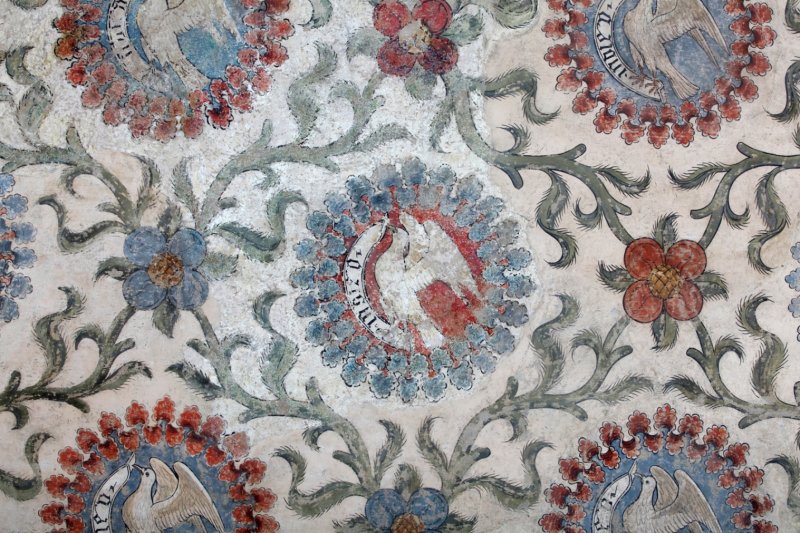
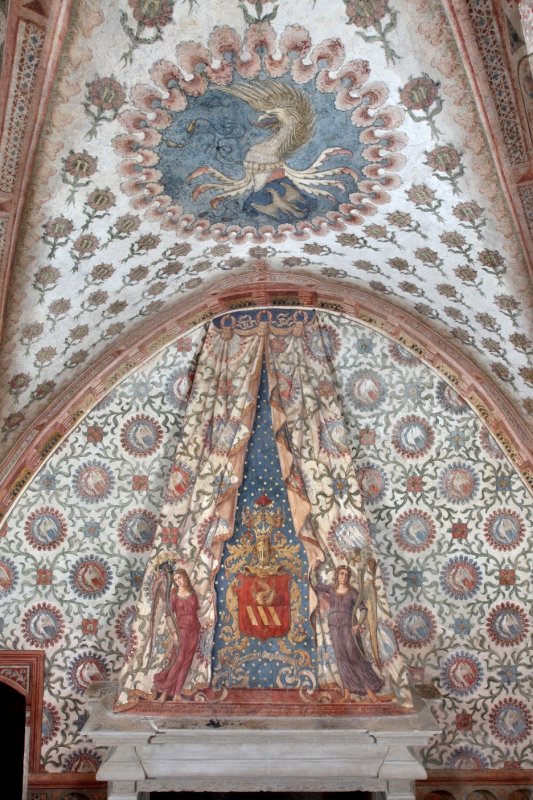
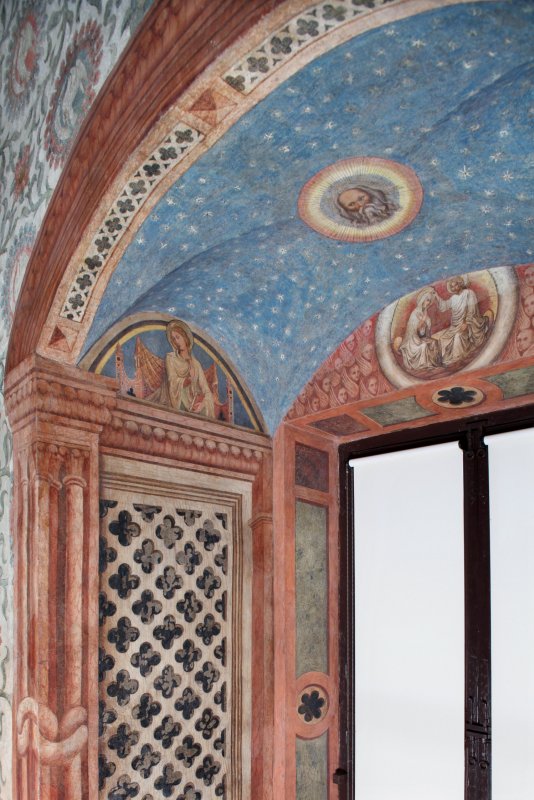
Predominating in this room is the feat of the white dove with outstretched wings on a blue or red background, holding the motto in Dieu, translated by some scholars as ‘toward heaven, on high.’ The dove symbolizes pure love, gentleness, gratitude, and moderation and is certainly placed in a devotional and religious context that was widespread in the Middle Ages. The close relationship of the decorations of this room with the religious sphere is highlighted by the presence, in the splay of the large window from which daylight enters, of frescoes depicting the Annunciation, the Coronation of the Virgin and the face of the Almighty. These themes recall, integrating them, the stories of Christ and Mary painted, also in the same years (1420), in the Contrari Chapel on the upper floor, a masterpiece of late Emilian Gothic.
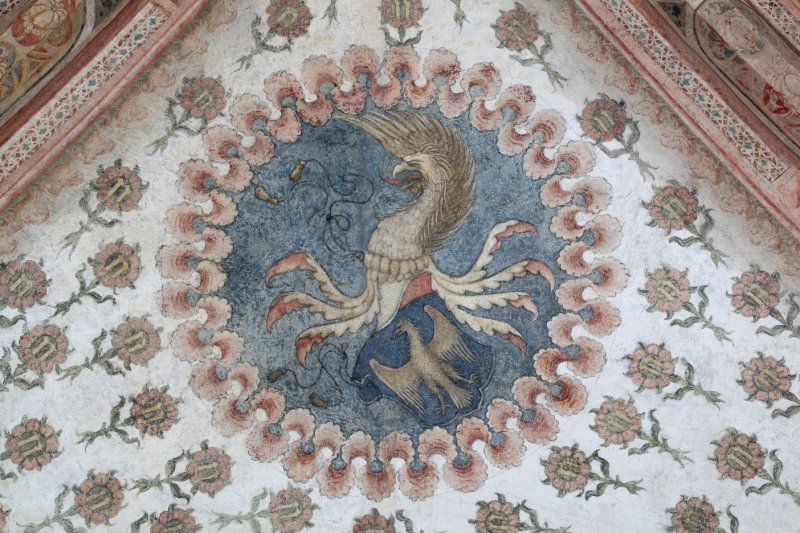
On the ceiling, in addition to the red and blue floral motifs that enclose the Gothic-style letters U and N, initials of Uguccione Contrari and Nicolò III d’Este, symbolizing the deep friendship that existed between the two, are depicted tournament shields with their respective helmets and crests. Recent restoration by the Fondazione di Vignola, under the direction of Prof. Bruno Zanardi, has brought to light the splendor of the frescoes, which had been covered by an antiquing patina during the restorations ordered by the Boncompagni-Ludovisi family in 1920-23. Thanks to chemical analysis and historical research, it was possible to confirm that the current decoration is absolutely consistent with that wanted by Uguccione Contrari in the second decade of the fifteenth century; the only addition, relatively recent, would seem to be that of the large fireplace on which the coat of arms of the Boncompagni-Ludovisi house stands out.
According to sources dating back to 1452, the room housed the courtroom in which the governor of the fief held trials and the Marquisate’s actuarial notaries drew up and kept records.